ARCHANGELS:
Ariel
COLOURS:
pink, red and white
THE ORIGINS:
History and Mythology
Origins and meaning of the name
Coral has been valued since ancient times, both for its beauty and for its alleged healing properties. The Celts even used it to decorate their horses, while the Greeks employed it medicinally. In the past it was also an item of trade, as Marco Polo testifies.
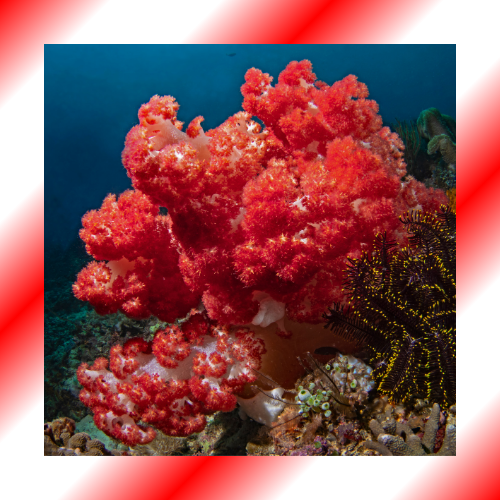
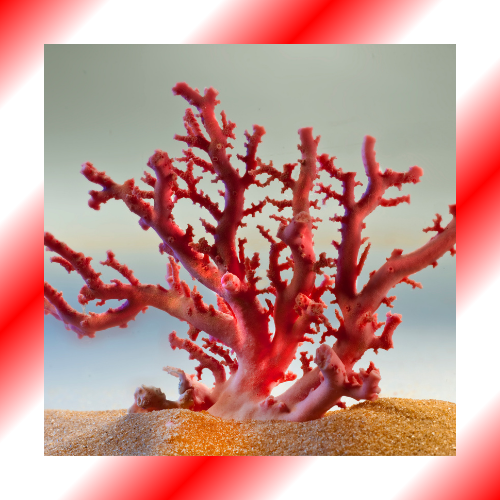
It is an organic material produced by small marine animals, polyps, which build solid skeleton-like structures, often in bright colors such as red, pink or orange. This makes it an organic gemstone, similar to pearls and amber.
In Greek myth, coral was born from the blood of the Gorgon Medusa, while many civilizations considered it a protective or healing amulet. It was present in religious rituals and sacred decorations in several world religions and cultures.
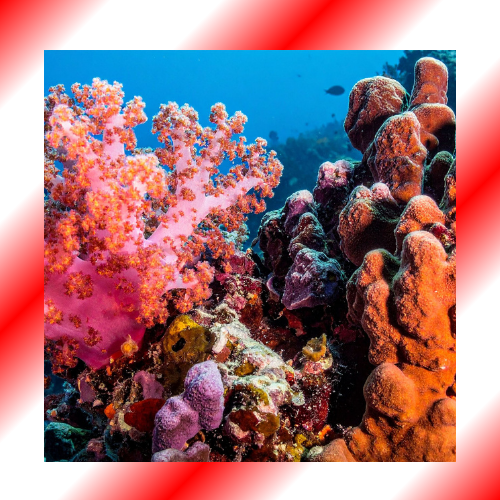
During the 1700s-1800s coral became particularly popular in Europe, and over time scholars have identified many different species. Its formation is slow: it starts from small larvae that build calcareous structures in tropical or subtropical waters.
.
History and significance
Used since prehistoric times throughout the Mediterranean basin.
The Celts also used it for equestrian ornaments.
The Greeks used it medicinally; linked to the myth of Perseus and Medusa.
In ancient times it also served as a currency of exchange.
Considered sacred by many religions: Islam, Christianity, Judaism, Buddhism, Hinduism.
In West Africa, it is a symbol of power and social status.
.
Formation and Origin
Organic gemstone produced by marine animals called coral polyps.
It is not a mineral, but a biological material similar to amber and pearl.
.
Main Colours
Red (most valuable)
Pink
Orange
White (rarer)
Black (in some cultures)
.
Organic origin
Polyps secrete calcium carbonate to create coral reefs.
Colonies grow slowly in warm, shallow water.
.
Main sources
Mediterranean Sea (excellent quality, especially Italy)
Red Sea
Indonesia (unique and highly valued models)
Japan, Hawaii, Australia, Philippines, Taiwan
USA: fossil coral in Florida and Georgia
.
Coral types and similar variations
Types of Coral
Colour depends on pigments (such as carotenoids) and can vary through mineral oxidation or artificial dyes.
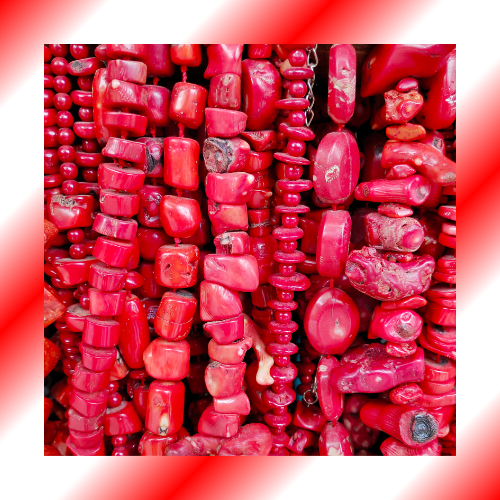
Calcareous corals (most common in jewellery) are red, pink, and white.
Horny or conchiolin corals are black, golden, blue or brown.
.
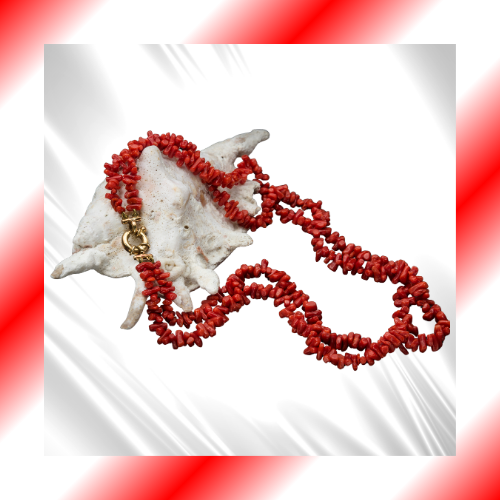
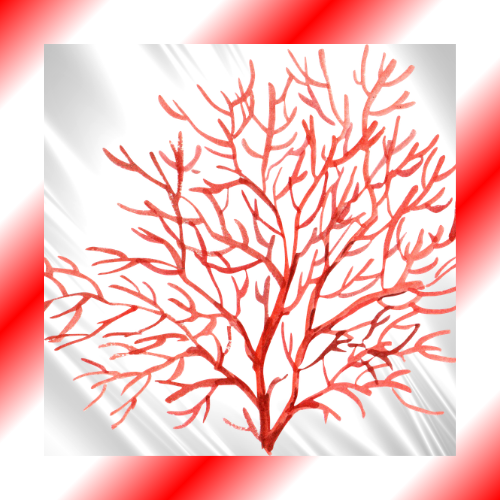
Red coral (Corallium rubrum)
The most valuable and used in jewellery making.
It is found in the Mediterranean, Red Sea, Japan.
Appreciated if bright and uniform red in colour.
.
Black coral
Derived from organisms with a horny skeleton (Gorgonia, Gerardia...).
Found in Hawaii, Red Sea, Australia, Antilles, West Africa.
Less valuable, little imitated.
.
White and pink coral
Originating in China, Japan, Taiwan.
Fine varieties: "angel skin" (deep pink, very rare and expensive).
.
Blue coral
Type
Semi-precious stone (but highly sought after)
Fossil coral forms also exist, often transformed into agate
.
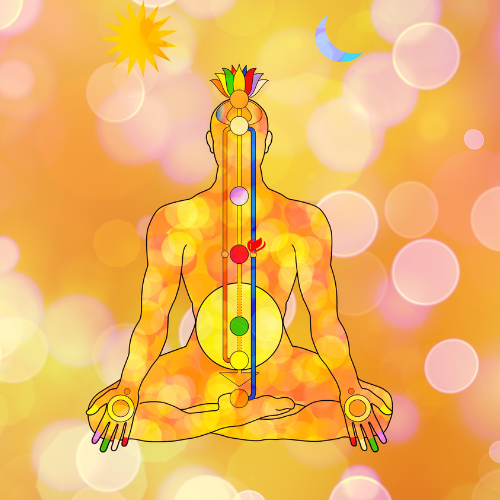
Chakra:
1st MULADHARA - the root
2nd SWADHISTHANA - the sacral
.
PROPERTIES, CHARACTERISTICS AND BENEFITS:
Mineralogical Characteristics
Coral:
Origin: Organic, used in jewellery; derived from the limestone skeleton of some marine cnidarians.
Composition: Mainly calcium carbonate (CaCO₃) in the form of calcite, with small amounts of magnesium and organic protein.
Hardness: 3.5-4 (Mohs scale)
Specific weight (density):
Refractive index:
Calcareous: 1.49-1.65
Horny corals: 1.54-1.56
Other properties:
Glossiness: Matte, waxy or glass-like
Fracture: Irregular
Strip: White
Transparency: Opaque or semi-transparent
Crystallinity: Absent (it is a mineraloid)
.
Highly valued for its ability to calm the mind and reduce anxiety and stress. Wearing them can promote a peaceful state of mind, improve mood and facilitate sleep, thus promoting greater emotional balance.
- Used since ancient times to create jewellery and amulets.
Associated with:
Vitality and energy
Emotional balance
Courage and inner transformation
.
Physical Properties and Health
Coral is also believed to have positive effects on the body, particularly on strengthening the immune system and stimulating blood circulation. It is also used to relieve inflammation, infection and skin problems such as eczema and acne.
Also employed for:
Skin problems
Circulation
Anxiety, insecurity and emotional stress
.
Relationships and connections:
Coral is also associated with improving interpersonal relationships, promoting harmony, cooperation and communication. It can help strengthen emotional and social ties, both in love and friendship.
.
Stimulation of creativity:
This stone is considered useful for people who wish to develop their creativity. It is said to stimulate imagination and personal expression, making it ideal for artists and people working in creative fields.
.
How to recognize real coral
It must show natural organic structure.
In contact with hydrochloric acid makes effervescence (for calcite) - test to be done only by experts!
❗ Common imitations:
Coral paste (resins + mineral powders)
Coral bamboo (dyed marine plant)
Plastic, glass, dyed shell
Dyed Madrepora
.
ZODIAC SIGNS
Coral and astrology:
In astrology, coral is linked to the planet Mars, a symbol of energy, courage and passion. It is particularly suitable for the signs Aries, Scorpio and Sagittarius, which can benefit from its energetic and motivational properties. To maximize its effects, it is recommended that coral be worn in direct contact with the skin, such as as a ring or pendant.
.
CLEANING AND RECHARGING:
Care and maintenance
Sensitive to bright light, heat, chemicals.
Avoid contact with chlorinated water, makeup, perfume, ammonia.
Wipe clean with soft, dry cloth, store in cool, dark place.
Over time it may deteriorate, but can be re-polished by professionals.